Keto vs intermittent fasting: which works faster?
Two approaches dominate every weight-loss conversation: the keto diet and intermittent fasting. Which one should you choose? What if the real answer is both?
Keto and intermittent fasting: quick definitions
The keto diet
A drastic reduction in carbs (<25 g/day) causes the liver to produce ketone bodies -- the body then uses fat as its primary fuel source. It is a permanent state of ketosis.
Intermittent fasting
Alternating between eating windows and fasting periods. Popular methods: 16:8 (16 hours fasting, 8-hour eating window), 5:2 (5 normal days + 2 days at roughly 500 calories), OMAD (one meal a day).
Comparison: keto vs intermittent fasting
| Criterion | Keto diet | Intermittent fasting |
|---|---|---|
| Speed of weight loss | Very fast in the first weeks | Gradual |
| Ease of adoption | Radical dietary change | Flexible |
| Hunger control | Very effective (ketones) | Variable |
| Metabolic health | Supports insulin and blood sugar | Supports autophagy |
| Athletic performance | 4-6 week adaptation period | Variable |
| Long-term adherence | Moderate | Good |
What the research says
On keto: a meta-analysis published in Obesity Reviews (2023) covering 13 studies concluded that the ketogenic diet produces faster weight loss than low-fat diets over 6 months.
On intermittent fasting: a study in Cell Metabolism (2022) found that 16:8 fasting reduces body fat by 3 to 8% over 8 weeks, without any other dietary change.
Combined: when you pair both approaches, you enter ketosis faster (glycogen stores deplete during the fasting window), you burn more fat during fasting hours, and hunger is generally better controlled.
Who should choose which?
Choose keto if
- You want fast results (an event coming up in 2 months)
- You have insulin resistance or prediabetes (with medical guidance)
- You experience frequent sugar cravings
- You want consistent mental clarity throughout the day
Choose intermittent fasting if
- You do not want to overhaul what you eat
- You enjoy late brunches and larger dinners
- You are looking for a sustainable long-term lifestyle
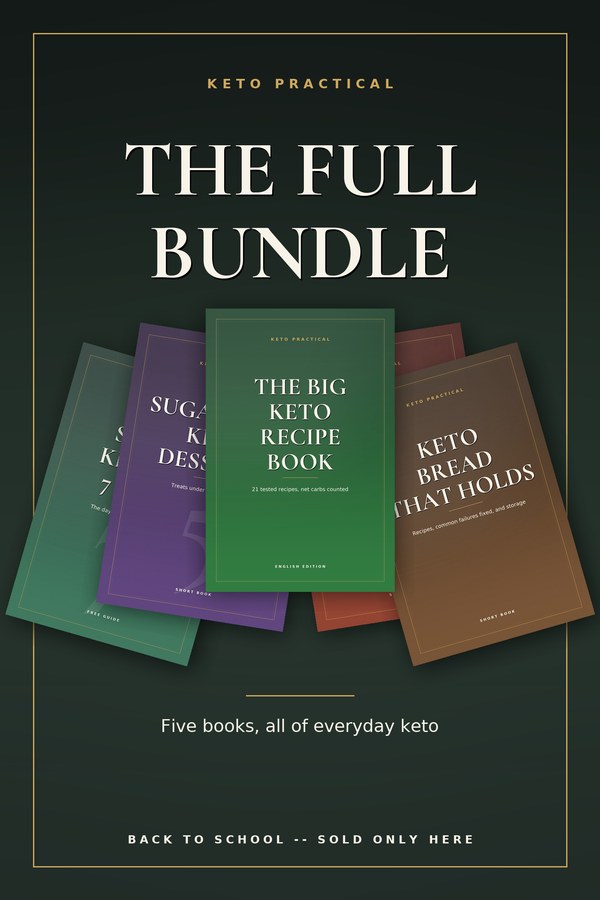
The Full Bundle: 5 keto books
The big recipe book, bread, pizza, desserts and the 7-day starter guide. Instant download, no account needed. Not on Amazon: sold only on our own sites.
- 5 books, 90+ pages
- Save $5.16 versus buying separately
- Instant download
The keto + fasting protocol by email
A week-by-week plan to combine both without derailing. Once a week, zero spam.
The keto + fasting protocol (beginner version)
Weeks 1-2: keto transition only. Gradually cut carbs to <25 g/day and eat 3 meals within a flexible window. Goal: reach stable ketosis.
Weeks 3-4: introduce 16:8. Last meal at 8 PM, next meal at noon. Black coffee, tea and water are allowed during the fasting window. Do not push through if you feel dizzy.
Week 5+: optimize. Try 18:6 if you feel good. A teaspoon of MCT oil in your morning coffee does not break ketosis. Supplement electrolytes to prevent cramps.
Frequently asked questions
Does Bulletproof coffee (butter coffee) break the fast?
Technically yes for autophagy, but it does not push you out of ketosis. Relevant only if your goal is weight loss, not autophagy specifically.
How much can you lose in 30 days combining keto + fasting?
Between 10 and 25 pounds depending on your starting point, with a good portion being water weight in the first two weeks. Real fat loss is closer to 4-9 pounds for the month. These figures vary significantly by individual.
Berberine: support for steady blood sugar
Both keto and intermittent fasting work in part by improving insulin sensitivity and stabilizing blood sugar. Berberine is a plant-based compound studied for its role in supporting healthy glucose metabolism -- a sensible addition during any low-carb or fasting protocol.
- Plant-based compound
- 60-day money-back guarantee
- Quality tested
Hundreds of keto cookbooks, all included.
Hundreds of keto cookbooks included with Kindle Unlimited - 30-day free trial. Read them on any phone, tablet or Kindle.
Start my 30-day free trialFree 30-day trial. Amazon partner link.